
The Question a Kid Asked an Astronaut: What Domecasting Actually Makes Possible

The Intuitive Planetarium in Huntsville, Alabama hosted a 25th anniversary event for NASA's Chandra X-ray Observatory, which has deep local ties: it launched on a shuttle commanded by Eileen Collins, and Collins was in the dome that night. Once the team started inviting other planetariums to join, a dome in Connecticut wrote back to say it would be bringing a guest of its own, the mission specialist from that same flight. So David Weigel's team rigged up a two-way link and let the two of them sit in separate domes and reminisce about their time on shuttle.
Then came the audience questions. Weigel had budgeted ten minutes. They ran for an hour, because at sites all over the map there were little girls on the microphone asking some version of the same thing: Miss Eileen, when you were sitting on that shuttle stack, were you scared?
"I'm not telling this little girl that she can't talk to Eileen Collins. Come on, dude." David Weigel, Director, Intuitive Planetarium
Domecasting is the practice of running a live planetarium show in one dome and broadcasting it out to other domes, so audiences in many theaters watch the same presenter at the same time and can talk back. It was the subject of our September 10, 2026 Fulldome Forum, the free monthly conversation Dome Fest West runs for the fulldome and planetarium community.
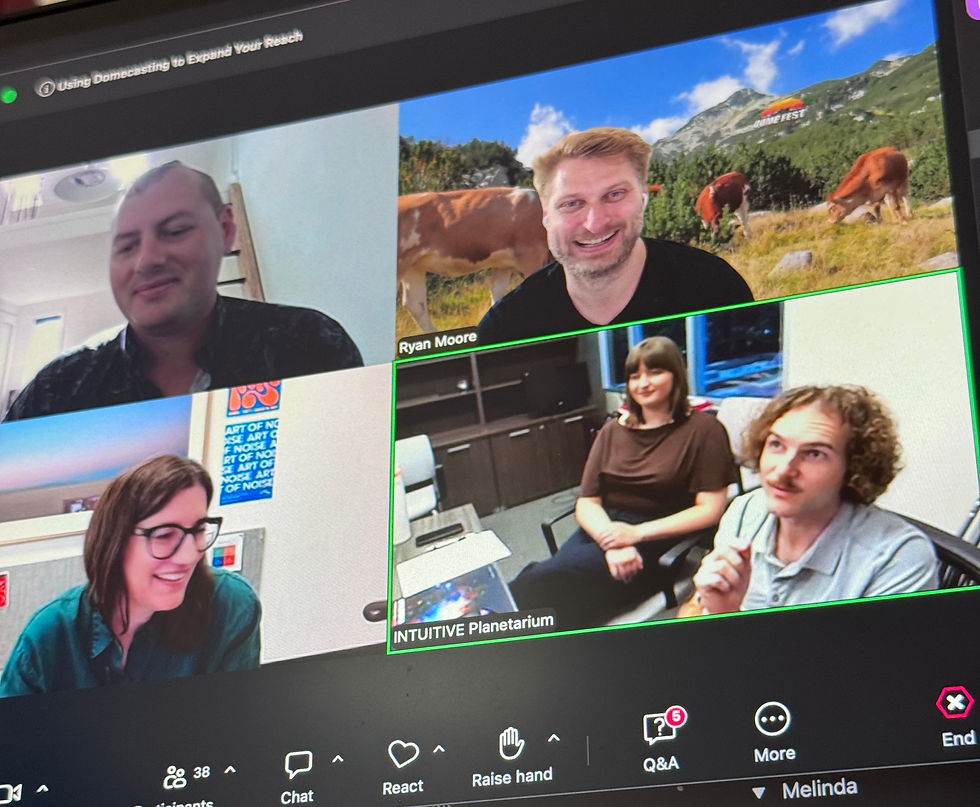
The panel: Melinda Orms, Senior Technical Product Manager for Digistar at Evans & Sutherland, a Cosm company; Dan Tell, owner and principal of Tau Immersive and formerly manager of planetarium engineering at the California Academy of Sciences; David Weigel, director of the Intuitive Planetarium at the U.S. Space and Rocket Center; and Brittany Kundert, assistant director of the same planetarium. Ed Lantz, our board chair, opened the session, and Ryan Moore hosted. Session details and panelist bios live on the event page for this Forum.
What is domecasting, and how is it different from dome streaming?
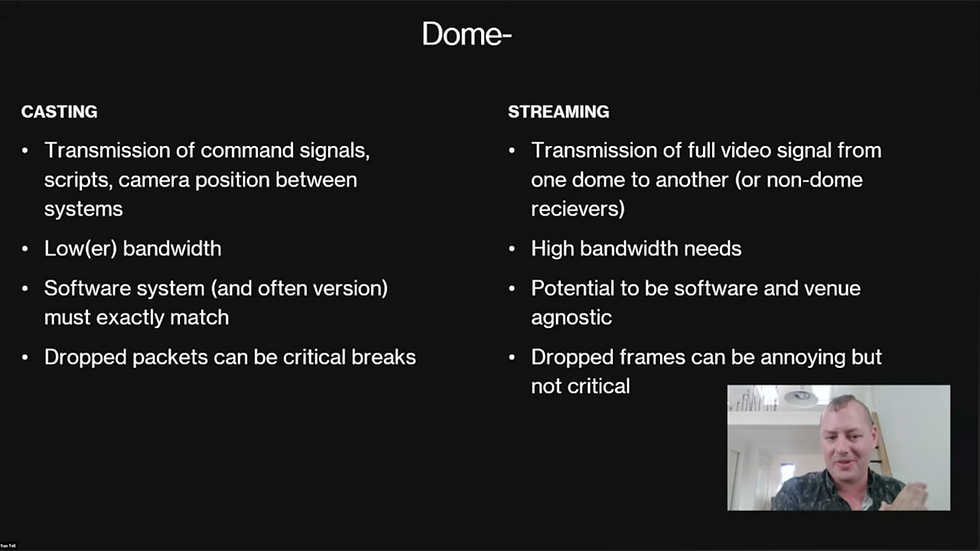
Domecasting sends scripting and camera-position commands between planetariums that are all running the same software, so each dome renders the show locally on its own hardware. Dome streaming sends the finished video signal instead, which takes far more bandwidth but can reach venues running other software, and viewers who are not in a dome at all.
Tell has been sharpening that distinction with an IPS thought group that includes Bjorn Voss at Planetarium Hamburg, Weigel, and Derek Demeter at Seminole State. His analogy for domecasting is an online game: "it's not sending the whole video signal of the scene back and forth to you. You're running the game locally and it's just sending commands back and forth between a central server." Cheap on bandwidth, but brittle. "Little things like drop packets can like completely break your show because suddenly you're not getting the updated camera positions from the host site."
Dome streaming, he said, "has the potential to be software system and venue agnostic." Potential is doing real work in that sentence, and he came back to it later in the session with a flat correction: "it is not agnostic. It is not clean." A stream still has to fit inside whatever resolution the commercial platforms allow, and it still lands differently on a 1K dome than on an 8K one.
Domecasting | Dome streaming | |
What crosses the wire | Scripting and camera-position commands | The whole video signal |
Bandwidth | Lower, in theory | Much higher, usually enough to require an IT conversation |
Software requirements | Every dome has to be in the exact same software environment, down to the build and the show package | Any site that can ingest a video; Digistar's version was built specifically for sites that are not Digistar customers |
Resolution behavior | Each site configures for its own system | Capped by the platform; YouTube tops out at 2K by 2K, because you get 2160p and only the vertical is usable on a square fisheye |
Failure mode | A dropped packet can break the show outright | Dropped frames, "more annoying than it is like a critical program-breaking thing" |
Best-suited content | Dense point clouds and live simulation, which encode badly to video because the pixels change too fast | Anything that compresses cleanly, and anything you would rather not have to debug remotely |
Interactivity | Two-way audio and video, with presenter control passed from dome to dome | One-way out from the host site |
Reach beyond domes | Domes only | Laptops, phones, VR headsets, anyone with the link |
That codec trade-off in row six came from Orms, and it is the most useful answer anyone gave to "which one should I pick." Weigel had just described flying through a galaxy simulation with eight million points in it. "Having all of those points on the dome and trying to encode those into video content is really challenging because of the frequency with which the pixels are changing in them," she said. "So in that case, having a real-time stream is going to give you better resolution in many cases on domes." A domecast can beat a stream on picture quality, but only for content that video compression handles badly.
Weigel's counterpoint runs the other way. A planetarium can patch its own show mid-performance and the audience never knows. "We can troubleshoot that rapidly behind the scenes in our dome, but we can't troubleshoot like that in somebody else's dome," he said. "Dome streaming solves that, because if it's working for me and I'm streaming it out, then it works for everybody, as long as you can keep that signal on your dome."
Can my dome actually join one of these?
Three ways, and they are not equivalent.
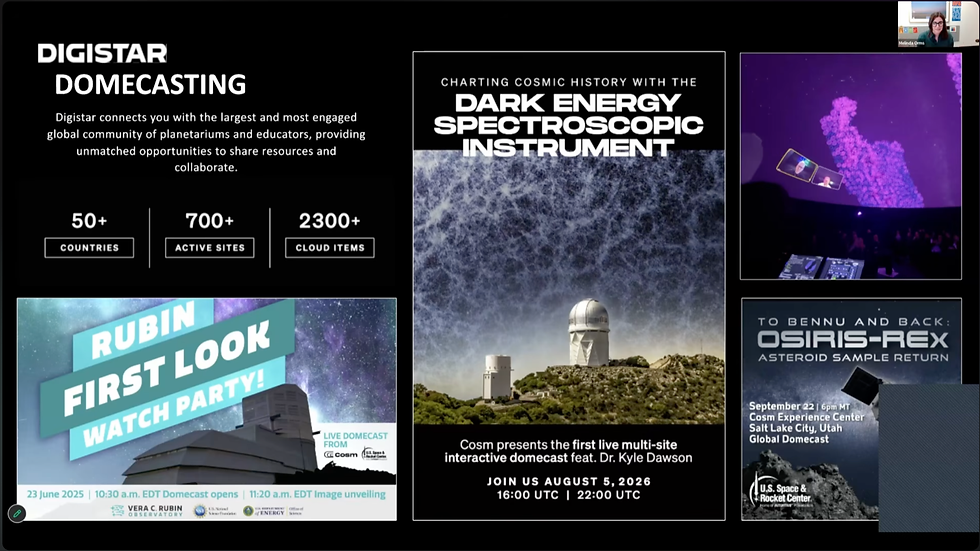
The first is natively, as a true domecast, which for Weigel's shows means Digistar 2026 specifically, not Digistar generally. The second is a 4K-by-4K fisheye stream, which the receiving venue ingests through its own playback software and puts on its own dome. Orms's team built that path deliberately for venues outside their customer base: "We've recently worked on the dome streaming to make these available for other sites that are not Digistar customers." The third is a 2K YouTube stream, open to anyone.
The catch is at the receiving end, and it is worth checking before you sign up for anything. "A lot of the existing software out there doesn't have the capability to pick up a stream of that resolution and get it up to the dome," Orms said of the 4K-by-4K feed. Weigel sees the same thing from the host side, repeatedly. Sites tell him they have a 4K system and can take the 4K stream, "and then it turns out when we have some back and forth that they unfortunately can't, because of their hardware or software or both." He does not blame anyone for it. "I speak the astronomy, maybe not as much the technical," is how he characterized the position a lot of planetarium staff are in, his own community included.
If you want to join a domecast this year, the practical move is to ask the host which of the three paths your specific software version supports, and then test it, rather than reading a spec sheet and assuming.
Vera Rubin Observatory "First Look": 60 domes, six continents, and an embargo
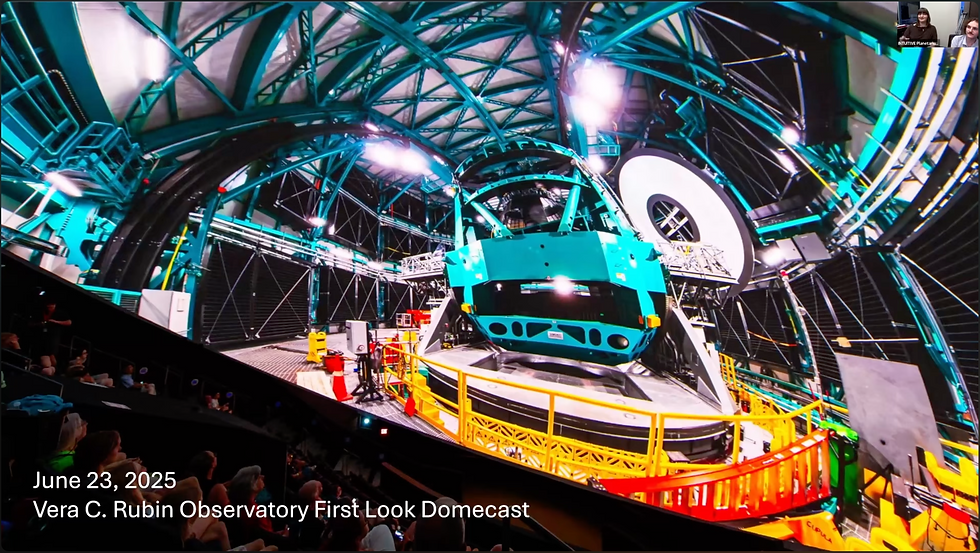
The biggest thing Kundert's team has produced was the Vera C. Rubin Observatory "First Look" domecast, and she called it the most logistically challenging one they have planned.
The domes ran as the immersive layer around NOIRLab's public livestream, before and during it. That meant working with embargoed images and getting them into a format that could be displayed at full resolution on a dome, all before the images existed publicly. More than 60 domes across six continents joined. "We alas did not get anyone into Antarctica," Kundert said. "So they should definitely build a planetarium there."
What she took away from it was less about the technology than about writing for an audience you cannot see. It "taught us just a bunch logistically, thinking through how to make content that is not just for your dome, but for many domes across the world for people of all different understandings of space, all ages, backgrounds, and so on."
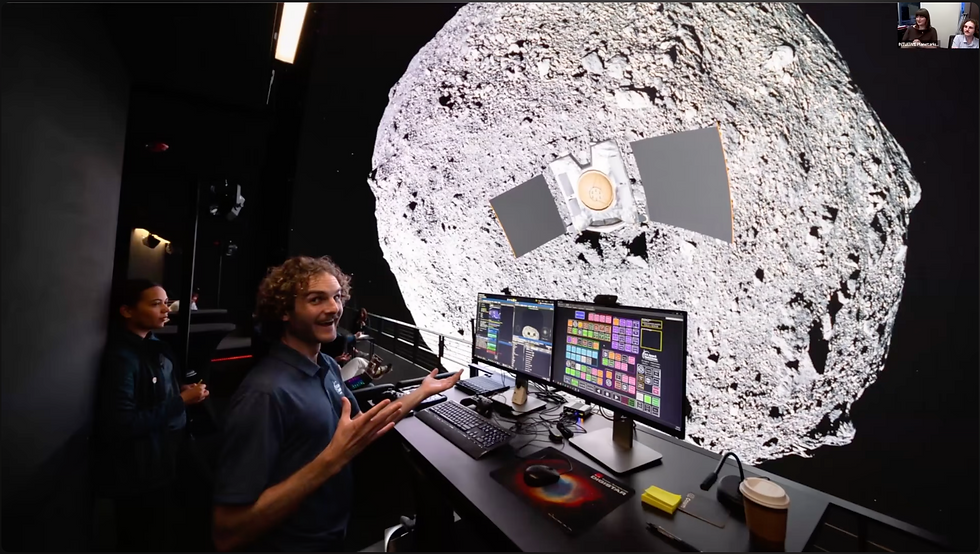
OSIRIS-REx: the mission manager flew out to present in person
On September 24, 2023, the OSIRIS-REx sample capsule came down outside Salt Lake City. It is Kundert's favorite space mission, and the night before the landing her team flew to Cosm's Experience Center in Salt Lake City to domecast an event around it.
They had an opening most venues would not: they had already worked with principal investigator Dante Lauretta. That relationship got them the rest. The show ended up involving the PI, the deputy PI, the project scientist, and the mission manager, and mission manager Solveig Irvine travelled to Salt Lake City to present it in person.
Kundert's explanation for why busy mission scientists said yes is the most transferable thing in the whole case study. "The sheer scope of people that we're able to reach with an event like a domecast is very attractive," she said, "and really incentivizes these very busy people who are working on the mission to be able to give us some of their time." The reach is the ask. A single-venue event is a favor. A network of domes is an audience.
Orms pointed back at that domecast later in the session for a different reason. What stuck with her was Irvine talking about the mistakes the team made and the things that surprised them once they started doing the work. Hearing a researcher describe the false starts, Orms argued, raises the perceived credibility of the science itself, and lets a kid in the seats work out that scientists are people who get things wrong and keep going.
Music of the Spheres: 15 domes, 15 custom encodes, and computers on fire
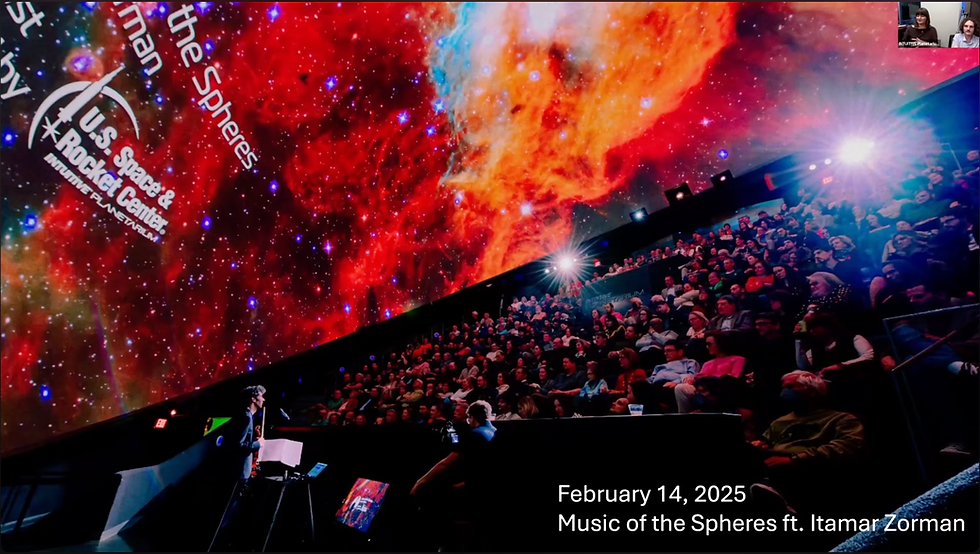
Subject matter expert talks are not the whole catalog. The Intuitive Planetarium also domecast Music of the Spheres, a performance by internationally acclaimed violinist Itamar Zorman, with visuals built specifically to accompany the pieces he played. Kundert described it as non-traditional planetarium programming, and as an argument that a domecast network is worth having for reasons that have nothing to do with a press conference.
The production story behind it is the most actionable thing anybody said all session, and it is a story about not trusting real-time rendering.
They were on an older generation of domecasting technology, and Weigel's team was not confident their content would render cleanly on other people's domes. So they gave up on real time entirely and rendered everything to video. Then, to get it onto each dome natively, they collected config files and encoding credentials from every participating site, roughly 15 domes, and encoded a unique video file per dome, sliced and encoded to match that site's channel count. Some venues got 14 files for 14 channels. Some got one. Every file carried an identical name, so each site's system played it natively without anyone having to rewrite a show.
"Our computers caught on fire encoding all of it," Weigel said. "And my hair caught on fire from the chaos of like, did we send all of them? I don't know. There were so many songs. I will never do that again. It was terrible."
It worked, though, and it is a real fallback if you have content you cannot trust to render remotely. Two costs to go in with your eyes open about: the encoding load is brutal, and someone at every receiving site has to be able to install the files. "That puts a little bit of onus on the site," as Weigel put it.
A galaxy simulation you can fly, live, on a controller
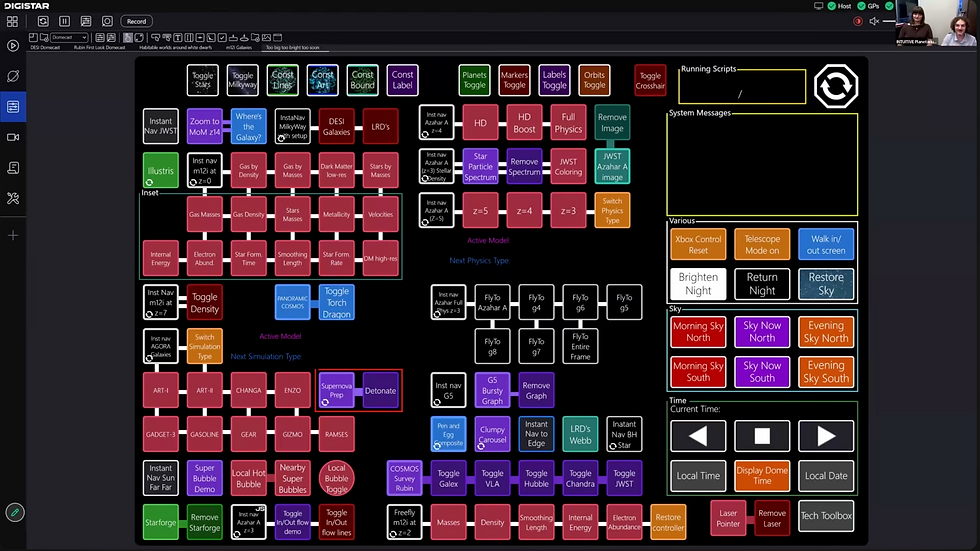
Weigel spent his slot building the next night's show instead of making slides for ours, then screen-shared the control panel anyway. The show featured Michelle Park, a master's student in the computational physics lab at Stanford, presenting her galaxy research, running on a Fire 2 cosmological simulation plus some more proprietary datasets, flyable live on a controller.
The interesting number is the downsample. One of the source simulations held about 280 million points. His system could render it, but he was not confident other domes could, and the artifacting was bad at full density. So they cut it to roughly 8 million points and tested until it held. That is the whole design philosophy in one decision: build for the middle of the field, not for your own rig.
He also made the case for putting real scientific plots on a dome, which planetarians tend to treat as a failure of nerve. Mid-flythrough he pulled up a synthetic spectrum of a single star as James Webb would observe it, color-coded by filter, wrapped across the whole dome. "It is a plot. Okay, it's a plot. Fine," he said. "But it's a fun plot, and it's a 360 plot, and it's taking advantage of the entire dome."
What still breaks, and what to do about it
The technical problems are being solved faster than the human ones. Here is what the panel would tell you to plan around.
Build a run of show from every site's point of view, not yours. Kundert had produced a new live show almost every week before her first domecast and still underestimated how different it is. "Audiences in other domes cannot see what's happening in your planetarium, nor can they hear anything that's happening unless it's spoken through the microphone," she said. A laser pointer is invisible to everyone but your own room. A question shouted from your back row has to be repeated into the mic with context, or the rest of the network is lost. Her fix is unglamorous and specific: sit down in advance and write out every minute, including which buttons get pushed when, from the perspective of every party on the call. Her team swapped the laser pointer for an on-dome cursor.
Rehearse with the receiving domes, not just your own. Weigel's team has learned more from partner sites telling them something looked wrong than from any internal test. "We have learned so much from all the sites that have tested with us and spent countless hours of like, nope, that kind of sucked." Orms's advice as the vendor in the room was the same: attend the practice sessions, host practice sessions if you are the host, and over-communicate during the live event while you monitor messages from other sites. Her reason is that every dome is a little bit bespoke. It is still the wild west, she said, once you account for audio configurations and specialty integrations out in the real world.
Design for the mid-range. Weigel targets what looks good on a 4K feed and stays legible on a low-resolution one. "We trend a little bit lower, but it's not going to look bad on a big dome. You're just not like, we're not going to get like the tiniest little points." If you are domecasting, each site can configure for itself. If you are streaming, you are sizing for whoever shows up.
Know the resolution math before you promise anyone anything. Everywhere outside a planetarium, "4K" means 4K by 2K, a rectilinear frame. In a planetarium, 4K means 4K by 4K, because the image is a square fisheye. Producing a true 4K-by-4K fisheye therefore takes an 8K stream, exactly double, which is a bigger ask than most people realize when they say the word. On the streaming side, YouTube's ceiling is 2K by 2K for the specific reason that you get 2160p and only the vertical dimension is usable. Facebook is the same, and so is nearly every other consumer platform.
"We're in this Wild West and we are not the sheriff." Dan Tell, Owner and Principal, Tau Immersive
Bring IT in before you design around a bandwidth number you do not have. Tell spent five years at the California Academy of Sciences arguing with the institutional IT department about what a planetarium needs, including setting the network up exactly the way they specified and then demonstrating that it broke the planetarium. He never won it. "We never got our IT department to shape and sculpt our bandwidth," he said, and the reason is worth memorizing: the equipment had already been bought before the planetarium was part of the conversation, so there was no capacity left to allocate. He does not frame this as anyone's personal failing. Enterprise IT training does not cover AV over IP, planetarium staff do not speak the language IT uses to assess risk, and a decade of bad conversations has left real damage on both sides. Get into the procurement discussion early, or inherit a number you cannot change.
Assume you will not get enough rehearsal time with your guest, and that they will want to rebuild everything when they finally see the dome. Both Weigel and Tell named this as the unsolved problem. Recruiting a subject matter expert is hard. Getting them to understand that a dome is not a PowerPoint is harder, and if they are not local, the first time they stand under it may be the night before. "Inevitably, the person comes into the dome, their mind is blown, their eyes get huge, and they're like, it could have been so much more," Weigel said. "I'm like, I know." Tell's version: most researchers have not been inside a planetarium since elementary school and have no idea what the medium does now. Nobody on the panel had a fix. Getting the expert into a dome, any dome, months earlier is the only lever anyone named.
Budget staff time, not dollars. Nobody mentioned money once in ninety minutes. No licensing fee, no per-site charge, no cost of entry came up at all, from the vendor on the panel or from the two venues that have hosted some of the largest domecasts in the field. What the panel treated as the real cost was labor: the run of show, the rehearsals, the testing calls, the encoding. If money is a factor at your venue, ask the host directly, because the session does not answer it either way.
Subtitles and automatic translation came up in the audience Q&A, from Dario. Everyone wants it. Orms is laying foundations for it. Weigel had an intern conversation about it the morning of the Forum. Nobody has it yet.
Where this goes next
Tell made one structural prediction worth writing down. Cross-vendor domecasting interoperability, in his read, is probably never happening. "Sending real-time commands between systems, we'll probably just never get there." Streaming interoperability is a different story, because "anyone can ingest a video, should be able to ingest a video." His candidate for a bridge is OpenSpace, as an open-source layer any system could add on top of whatever it already runs, which would give real-time programs a common go-between without asking the vendors to agree on anything.
Kundert's closing argument is the one most likely to change what a venue does on Monday. Planetariums are not in direct competition with each other, she said, so sharing benefits everybody. And the network already exists: hundreds of facilities already embedded in their own communities, already trusted, already doing what large research agencies say they want to do. "We are doing exactly what agencies like NASA want to do themselves in directly connecting with the public," she said. Her view is that agencies do not use that network nearly as much as they could.
If you want in, there is no clean public calendar yet. Cosm and Evans & Sutherland announce upcoming domecasts in their customer newsletter, and Orms said a public website listing them is in development. She named discoverability as an open problem and asked for ideas. Tell, now consulting independently through Tau Immersive, offered himself for the messier side: talking to your IT department, adding capability to your theater, working out whether OpenSpace belongs in your workflow. "If there's any way that you need help, I'm someone who can reach out to," he said. "And if I can't help you, I'm always very happy to recommend someone who actually can."
Forum Speakers
Melinda Orms, Senior Technical Product Manager, Digistar, Evans & Sutherland (a Cosm company)
Dan Tell, Owner and Principal, Tau Immersive
David Weigel, Director, Intuitive Planetarium, U.S. Space and Rocket Center
Brittany Kundert, Assistant Director, Intuitive Planetarium, U.S. Space and Rocket Center
Ed Lantz, Board Chair, Dome Fest West (opened the session)
This is a portion of a 90-minute conversation. The full recording, including the audience questions on subtitling, resolution agnosticism, and how to make a chart worth putting on a dome, is on YouTube.
Fulldome Forums are free, monthly, and open to anyone in the community. The next one, on October 15, turns to careers and how to launch a fulldome journey if you are just starting out, with Javier Bollaín, Tara Rose Morris, Ryan Hartsell, and Michel D.T. Lam, hosted by Kelley Francis. Browse upcoming Forums, or suggest and vote on the topics you want us to cover in 2027.


Comments